Why Clean Paint Still Feels Rough: The Bag Test
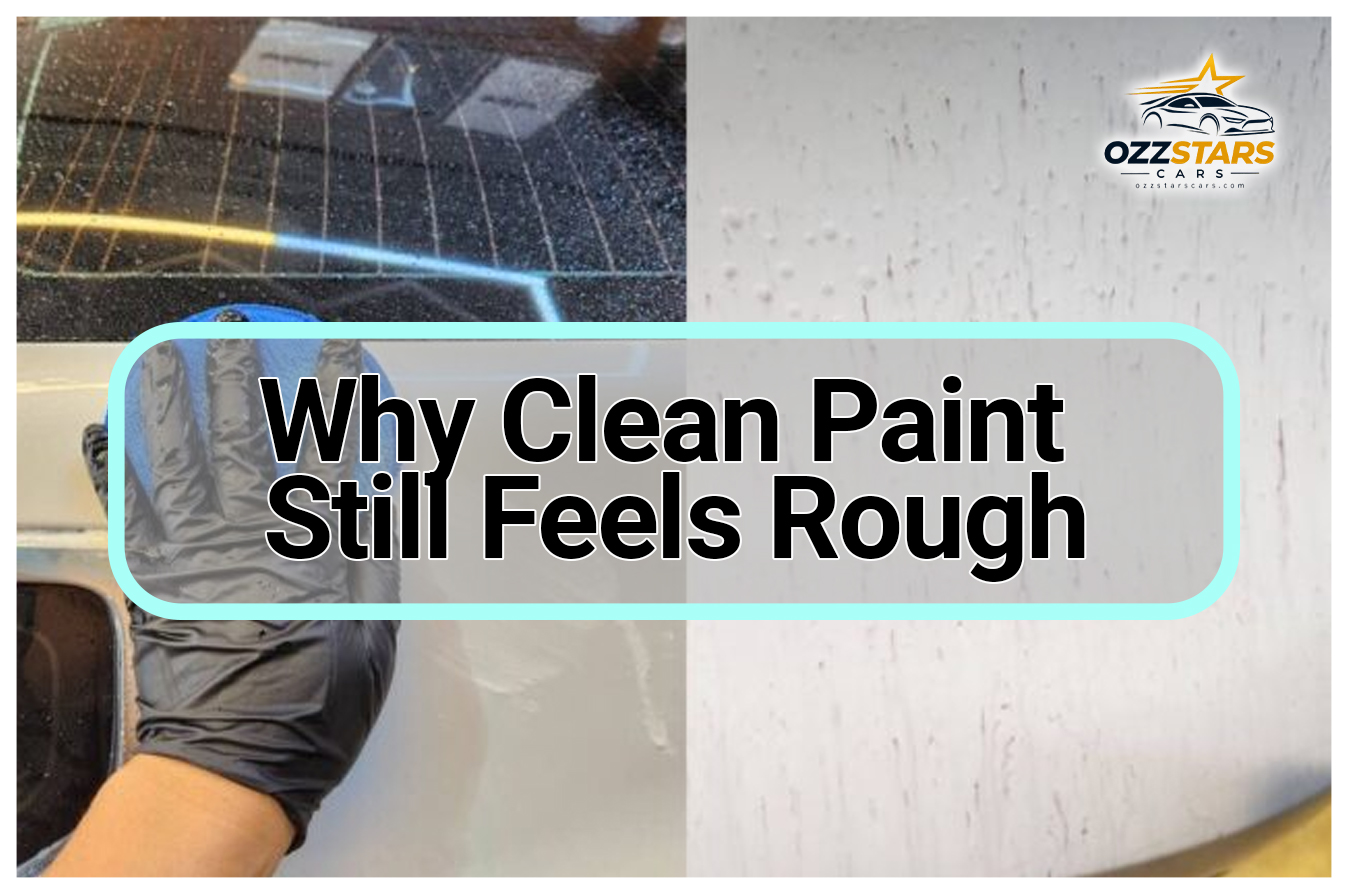
You washed the car properly. It looks right. Then you run your hand over the hood and it feels like fine sandpaper.
Nothing went wrong. A wash and a decontamination are two different jobs, and you have only done one of them.
The distinction the whole subject turns on
A wash removes what is sitting on the paint. Dust, road film, dirt, bird mess, most of what accumulates in a week.
Decontamination removes what is stuck in it. Particles that have physically bonded to or embedded into the surface and are no longer being held there by dirt.
Soap cannot lift something that is mechanically embedded, and no amount of better technique changes that. This is why "wash it again more carefully" is the wrong answer to a rough-feeling car, and it is what most of the advice on this query amounts to.
The test that costs nothing
Wash and dry the car. Then take an ordinary thin plastic sandwich bag, put your hand inside it, and glide your fingertips lightly over the paint.
The bag amplifies texture. Your bare hand cannot feel most of this and through a thin bag it becomes obvious. Somewhere between "smooth as glass" and "like a fine emery board" is what you are reading.
Do the horizontal panels first. The hood, the roof and the trunk lid are where fallout lands, and they are almost always worse than the doors. If the roof feels rough and the doors feel smooth, that is the diagnosis, because it is a pattern that gravity explains and washing technique does not.
Do it before you assume the wash was bad. Half the people who arrive at this question have a perfectly good wash routine and a car that has not been decontaminated in years.
What is actually stuck in there
Four things, and they need different removal:
Industrial fallout, mostly iron. Tiny metal particles from brake dust, from railways, from industry. They land hot, they embed, and then they rust in place. This is the one that produces the classic orange specks on white paint and it is the most common single cause of a rough roof.
Tree sap and honeydew. Sticky when it lands, hard and glassy after it bakes.
Tar and road film. Lower panels, behind wheels, along sills.
Overspray and paint transfer, if the car was parked near work being done, or brushed something.
They are not all removed the same way, which is why "clay the car" is an incomplete instruction.
The order that avoids doing damage
This is the part where the sequence genuinely matters, because the whole risk in decontamination is dragging a hard particle across soft paint.
1. Wash first, properly. Everything loose has to be gone before you touch the surface with anything. Decontaminating a dirty car is how you put swirl marks in it, which is the same mechanism described in how swirl marks actually happen, just at a different point in the process.
2. Chemical decontamination before mechanical. Dissolve what can be dissolved before you drag anything across the surface. Iron removers and tar removers do this, and every particle they take off chemically is a particle you are not dragging. This is the step people skip, and skipping it makes the next step riskier for no benefit. The purple bleed people ask about belongs here and it has its own page.
3. Mechanical decontamination last, and only where the bag test says it is needed. Clay or a clay substitute, on what is left. This is a physical process on your paint and it has its own safety rules, which is why it is a separate article rather than a step in a list.
4. Protection afterwards, always. Decontamination strips whatever wax or sealant was on there along with the contamination. A decontaminated car with nothing on it is a car with less protection than it had this morning. If you do this and stop, you have made the paint cleaner and left it more exposed.
The thing that determines how often you need to do this
Where the car lives and what is above it.
Under a tree, near a railway line, near heavy industry, or parked outside all week in a city, and you will feel it building within months. Garaged, in a quiet area, and you may go a year or more.
We are not going to give you an interval, because the honest answer is that the bag test tells you and a schedule does not. That is the whole point of a test that costs nothing.
What we can say is that this is not a monthly job for anyone. Doing it more often than the paint needs is spending paint for no reason, which is the argument made properly in the article on why polishing is a finite resource.
What this is not
It is not paint correction. Decontamination removes things stuck to the surface. It does not remove scratches, swirls or defects in the clear coat, because those are not deposits, they are damage to the paint itself. A car that has been decontaminated and still looks dull in the sun has a correction question, not a cleanliness question, and that is a different and more expensive conversation.
It is not something a better wash routine achieves. Two buckets, grit guards and the right mitt protect the paint you have. They do not remove what is already embedded in it. The wash-side reasoning is in why the two bucket method exists and what a grit guard actually does.
It is not automatically needed. A car that passes the bag test does not need decontaminating, and doing it anyway is a small unnecessary risk taken for nothing.
FAQ
Why does my car feel rough after washing?
Because washing removes what is sitting on the paint and not what is embedded in it. Bonded contamination, most commonly iron fallout, sap and tar, stays behind and is what you can feel.
What is the bag test?
Put your hand in a thin plastic bag and glide your fingertips over washed, dried paint. The bag makes texture obvious that your bare hand cannot detect. Check the hood, roof and trunk lid first, because fallout lands on horizontal surfaces.
Do I need to clay my car?
Only if the bag test says so, and only after chemical decontamination has taken off what it can. Claying a car that does not need it is a small risk taken for no gain.
How often should I decontaminate my paint?
There is no interval worth publishing, because it depends entirely on where the car is parked and what is above it. The bag test answers it for your car, which a schedule cannot.
Do I need to reapply wax after decontaminating?
Yes. Decontamination takes off whatever protection was on the paint along with the contamination, so a car left bare afterwards is less protected than it was before you started.
This page names no product, no price, no dwell time and no dilution ratio. It publishes no tire pressure, tread depth, torque value, wheel load rating or load index, which is a standing rule on this site.
The bonding and removal mechanisms described are general detailing knowledge stated as such. No product was tested for this page and nothing here is presented as a test result.