Clear Coat Is Finite: Polishing Is a Resource You Spend
We are not going to give you a number, and the reason is the article.
You will find numbers. You will find "two or three times in a car's life", "five times", "as long as you have enough clear coat left". Every one of them is either a guess or a figure about a specific car being presented as a general one, and the difference between those two things is the difference between useful and dangerous here.
A wrong number on this page costs the reader a repaint. So there is no number on this page.
Why the question has no general answer
Four variables, none of which a webpage can know about your car.
How much clear coat it left the factory with. This differs between manufacturers, between model years, between the paint colors on the same car, and between panels on the same car. A vertical panel and a horizontal one are not necessarily the same.
How much is left now. Which depends on the car's age, its exposure, and whether any of its panels have been refinished. A panel that has been repainted at a body shop has a different clear coat thickness from the one beside it, and frequently a thinner one, and the owner very often does not know it happened.
What was removed by every previous polish. Which depends on the product, the pad, the machine, the pressure, the number of passes and the person. These are not standardized and cannot be added up.
How deep the defects are that you want to remove. Which sets how much has to come off this time.
Four unknowns multiplied together do not produce a number. They produce a range so wide it means nothing, and a page that gives you the middle of that range is giving you a figure that is wrong for most readers in one direction or the other.
What "spending" actually means
Almost all modern car paint is clear coat over color. The clear layer is what protects the color from ultraviolet light and from everything else. It is what gives gloss and it is what gets damaged.
It is not replenished. No product adds clear coat. Waxes, sealants and coatings sit on top of it; they do not become it.
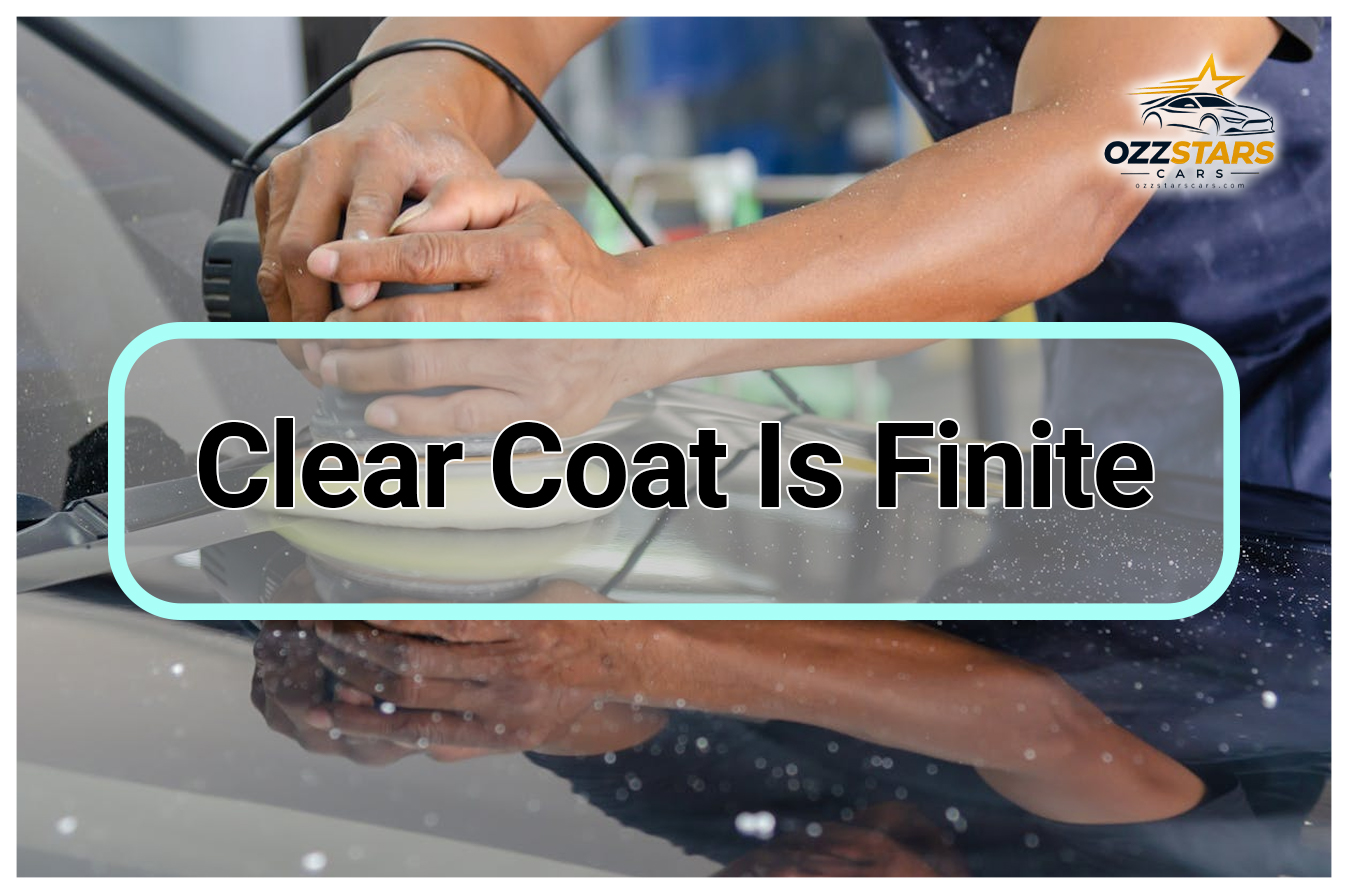
Every abrasive pass removes some of it. That is not a criticism of polishing, it is the mechanism by which polishing works: compound removes more clear coat, polish removes less, and a glaze removes none and hides what it cannot remove.
And when it runs out, the failure is not gradual and pretty. Clear coat failure looks like cloudy patches, then flaking, then peeling, usually starting on the roof and hood because that is where the sun is. It cannot be polished back and it cannot be topped up. The panel is repainted or it stays like that.
What actually answers the question for your car
One thing: a paint depth gauge, used on your car, by someone reading it.
It measures the coating thickness on each panel. A competent detailer measures before correcting, and one who does not is working blind on a finite resource.
Two honest observations about that.
A gauge reading is not a simple number either. Most consumer gauges read total coating thickness, not the clear layer alone, so the interpretation matters as much as the reading.
And we are not going to publish what reading means what. That is exactly the arithmetic that goes wrong, and it depends on the vehicle.
What you can do with this without buying anything: ask. If you are paying for correction, ask whether they measure. The answer tells you a lot about who you are dealing with, and it is a better filter than any review.
The framing that makes this a real decision
You are not choosing between a corrected car and an uncorrected car. You are choosing between using some of your car's remaining clear coat now and having it later.
That framing makes several things obvious that are otherwise arguable:
Correcting a car you are selling next month is spending the buyer's clear coat.
Correcting the same swirls every year because the wash routine puts them back is spending a finite resource on a recurring problem with a free fix. The fix is in how swirl marks actually happen and in drying without scratching, and between them they are why this site's first cluster comes before this one.
Correcting a defect that only appears under a inspection light in a dark garage is spending paint on something you will not see.
Correcting an old car with unknown history is the highest-risk version, because the paint is thinnest, the history is unknown, and previous work is likely.
Where the SERP's incentive sits
In the SERP checks recorded when this site's topical map was built, dated 2026-08-22 and kept in this site's own evidence file, the paint protection and correction queries were dominated by coating installers, detail shops and chemical brands, with each installer page concluding the work was worth doing and ending in a booking form.
That is not an accusation of dishonesty. It is the observation that the pages answering "how many times can you polish a car" are mostly written by people who would like to polish it. The sentence "your car has a limited number of these left and you should ration them" is not one a booking page can carry.
The practical rules that follow
Correct as little as possible, as rarely as possible.
Least aggressive product that works, always. Test on a small area first.
Prevent instead of correct. Every swirl you do not create is clear coat you do not spend.
Protect afterwards, every time. A sealant or coating over corrected paint is what keeps you from doing it again next year.
On an older car, be more conservative rather than less. The temptation runs the other way, because older paint looks worse.
If you do not know whether a panel has been repainted, assume it might have been.
Ask for a measurement before paying anyone to remove clear coat.
FAQ
How many times can you polish a car?
There is no general answer, and this page refuses to give one. It depends on the original clear coat thickness, how much is left, what previous work removed, and how deep the current defects are. Only a measurement on your own car answers it.
Can polishing wear through clear coat?
Yes. That is the risk the whole subject is organized around, and it is why the least aggressive product that works is the right one and why prevention beats correction.
What happens when clear coat fails?
It goes cloudy, then flakes, then peels, usually starting on the roof and hood. It cannot be polished back or topped up. The panel is repainted or it stays that way.
How do I know how much clear coat my car has left?
A paint depth gauge used on your car. Most consumer gauges read total coating thickness rather than the clear layer alone, so the interpretation matters, and it is a job for someone reading your specific car.
Should I ask a detailer if they measure?
Yes, and the answer is informative. Correcting without measuring is removing a finite material without knowing how much of it there is.
Sources: the SERP composition described above is from this site's own recorded topical-map evidence, dated 2026-08-22 and held in this site's archive. It is first-party research by this site, not a claim about any named business.
This page deliberately publishes no clear coat thickness figure, no paint depth gauge reading, no removal-per-pass figure and no count of polishes. It names no product, machine or price, and it publishes no tire pressure, tread depth, torque value, wheel load rating or load index, which is a standing rule on this site.
No polishing was performed for this page and nothing here is presented as a test result. The clear coat failure mechanism described is general coatings knowledge stated as such.