Scratch Depth: The Fingernail Test and What It Tells You
There is one question and you can answer it yourself in ten seconds.
Can this be polished out, or does it need paint? Everything else, the products, the prices, the quotes, is downstream of that, and it costs nothing to find out.
The test
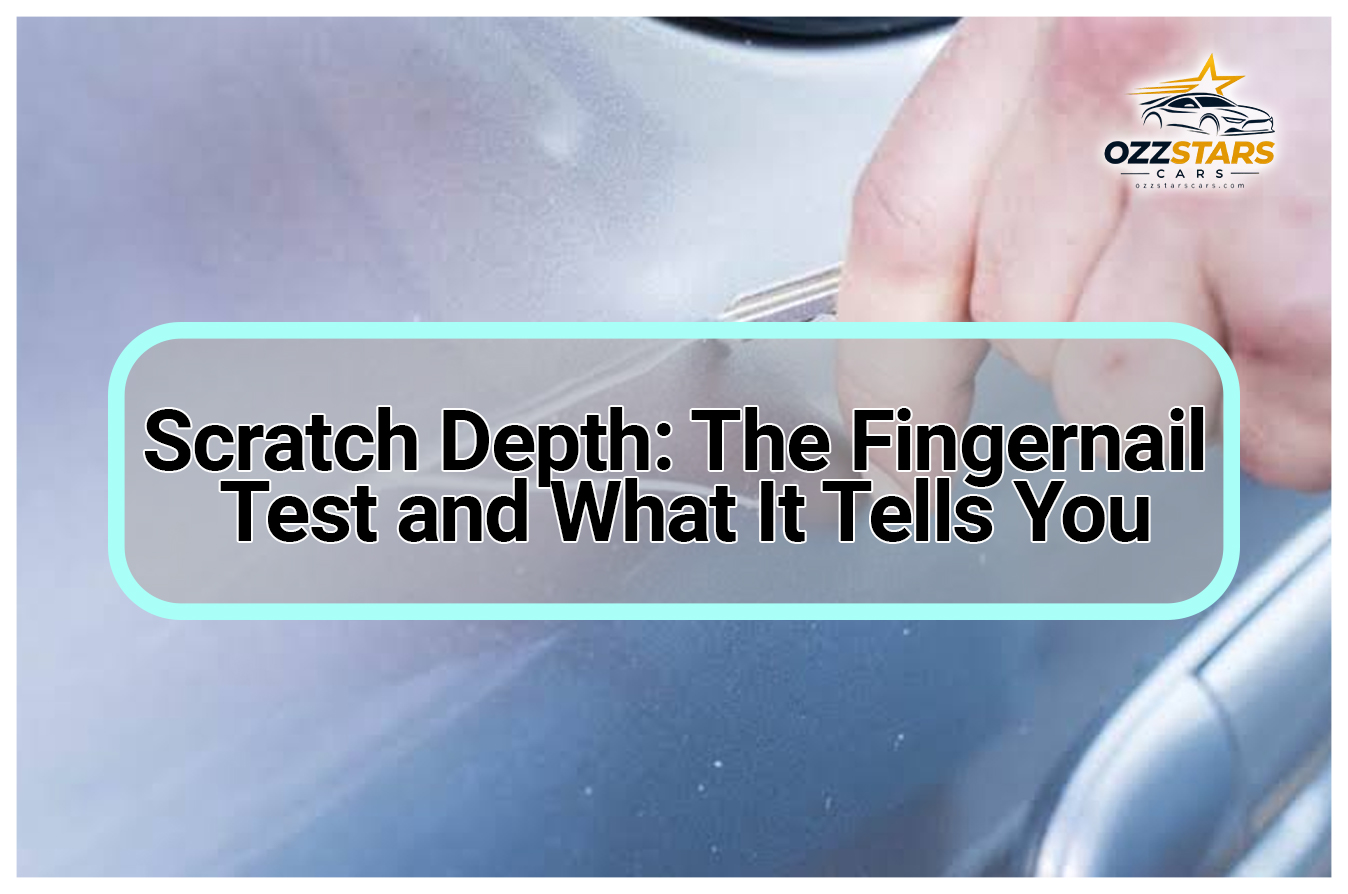
Run a fingernail lightly across the scratch, at right angles to it. Clean nail, clean paint, no pressure.
If your nail glides over and does not catch, the scratch is shallow and is very likely within the clear coat. That is a polishing job.
If your nail catches in it, the scratch has depth. It has probably gone through the clear coat, and possibly into the color or further. That is not a polishing job.
Do it on a clean, dry, cool panel. Dirt in the groove changes what you feel, and it is the most common reason this test gives a wrong answer.
What the test is actually reading
Almost all modern car paint is layered: primer, color, then clear coat on top. The clear coat is the thick transparent layer that carries the gloss and takes the damage.
Correction works by removing clear coat down to the level of the bottom of a defect. So the whole question is whether the defect's bottom is still inside the clear layer.
Your fingernail is a depth gauge with a very coarse resolution, and coarse is enough here, because the thing you are trying to distinguish is "somewhere in a transparent layer" from "through it".
What you see also tells you something
Color visible in the scratch. The clear coat has been breached. Polishing removes more clear coat around a defect that already has none.
White or gray visible. That is often primer, and it is deeper again.
Bare metal, shiny or already rusting. Deepest, and now urgent for a different reason: an unprotected steel panel corrodes, and it does so from the scratch outward under the surrounding paint.
A scratch that disappears when wet. Wet the panel. If the mark vanishes while wet and returns as it dries, that is a strong indication the defect is shallow enough that filling it optically resolves it, and therefore shallow enough that levelling to it is plausible.
This wet test is the best free companion to the fingernail test and almost nobody mentions it.
Where the test is unreliable, stated honestly
On a panel that has been repainted. Refinished panels can carry a different clear coat thickness from the factory ones beside them, often thinner. A scratch that would be safely correctable on an original panel may not be on a repainted one, and the owner frequently does not know a panel was repainted.
On very old or already-thin paint. The nail says the scratch is shallow; the paint may not have enough left to spare.
On soft paint. Some manufacturers' clear coats are noticeably softer than others. It does not change what the test reads, but it changes how easily further damage happens during any work.
On matte or satin finishes. Everything inverts and standard correction is not applicable.
On plastic bumpers with flexible finishes, which behave differently from a metal panel.
When you cannot tell. A borderline catch is a real result and it means the answer is uncertain, and uncertain is exactly the situation where the low-cost path is to ask someone with a paint depth gauge rather than to start removing material.
What the answers mean
Nail glides, no color visible: a polishing question
Try the least aggressive product that could work, on a small test area, and see whether it resolves. Polish before compound, always. Reaching for compound first is how people spend clear coat on defects that polish would have handled.
And before any of that, wash and decontaminate, because working abrasive product over embedded grit drags hard particles through your paint, which is the same mechanism as how swirl marks are created, only under pressure.
Nail catches, color visible: not a polishing question
Correction cannot fix this and attempting it makes things worse, because levelling to the bottom of a through-clear-coat scratch means removing all the clear coat around it.
The realistic options are touch-up paint, which sets expectations rather than restores appearance, or a body shop. Both have their own honest limits and neither is on this page, because a repair that involves refinishing is out of a detailing site's competence and into a trade's.
We publish no repair cost figure. It depends on the panel, the paint, the vehicle and the local market, and a number here would be invented.
Bare metal or rust already showing: time matters
Sealing it against moisture is the priority, ahead of how it looks. A scratch to metal left through a wet season is a rust question rather than a cosmetic one, and rust under paint spreads out of sight.
The scratch that is not a scratch
A large proportion of what people call scratches are transfers, not scratches.
Paint transfer from another car, a wall or a post sits on your paint rather than in it. Your nail glides over it and it is not a defect in your clear coat at all.
The tell is color that is not your car's color, sitting proud, sometimes in a smear rather than a line. These frequently come off with far less aggression than a scratch needs, and sometimes with nothing more than decontamination.
Check for this before assuming the worst, because the difference between a transfer and a scratch is the difference between a wipe and a repaint.
What we will not tell you
Which scratch remover pen or product to buy. We have tested none and this site carries no picks.
A clear coat thickness figure. Publishing one invites arithmetic about how much correction a car has left, and that depends on the vehicle, its paint, its history and any previous work. A wrong number here costs the reader a repaint.
That any scratch "will" come out. It depends on depth, on how much clear coat remains, and on what has already been done to that panel.
How to do body work. That is a trade and this is a detailing site.
FAQ
How do you tell if a scratch can be buffed out?
Run a clean fingernail lightly across it at right angles. If the nail glides over, the scratch is probably within the clear coat and is a polishing job. If it catches, it has depth and is not.
What does it mean when you can see color in a scratch?
The clear coat has been breached. Correction removes clear coat, and there is none left in the scratch to remove, so polishing cannot level it.
Why does my scratch disappear when the car is wet?
Water fills the groove and stops it scattering light, which is a good sign that the defect is shallow. It is the same optical effect a glaze produces, and it is a useful free test alongside the fingernail one.
Is a scratch to bare metal urgent?
More urgent than a cosmetic scratch, because unprotected steel corrodes and rust spreads under the surrounding paint. Sealing it against moisture matters more than how it looks.
Could it be paint transfer rather than a scratch?
Often, yes. Transfer sits on your paint rather than in it, your nail glides over it, and the color is not your car's color. It usually comes off with far less aggression than a scratch would need.
This page names no product, no price, no clear coat thickness figure and no repair cost. It publishes no tire pressure, tread depth, torque value, wheel load rating or load index, which is a standing rule on this site. Body shop work is routed out rather than described.
The paint layer structure, the depth test and the corrosion mechanism described are general automotive finishing knowledge stated as such. No correction or repair was performed for this page and nothing here is presented as a test result.