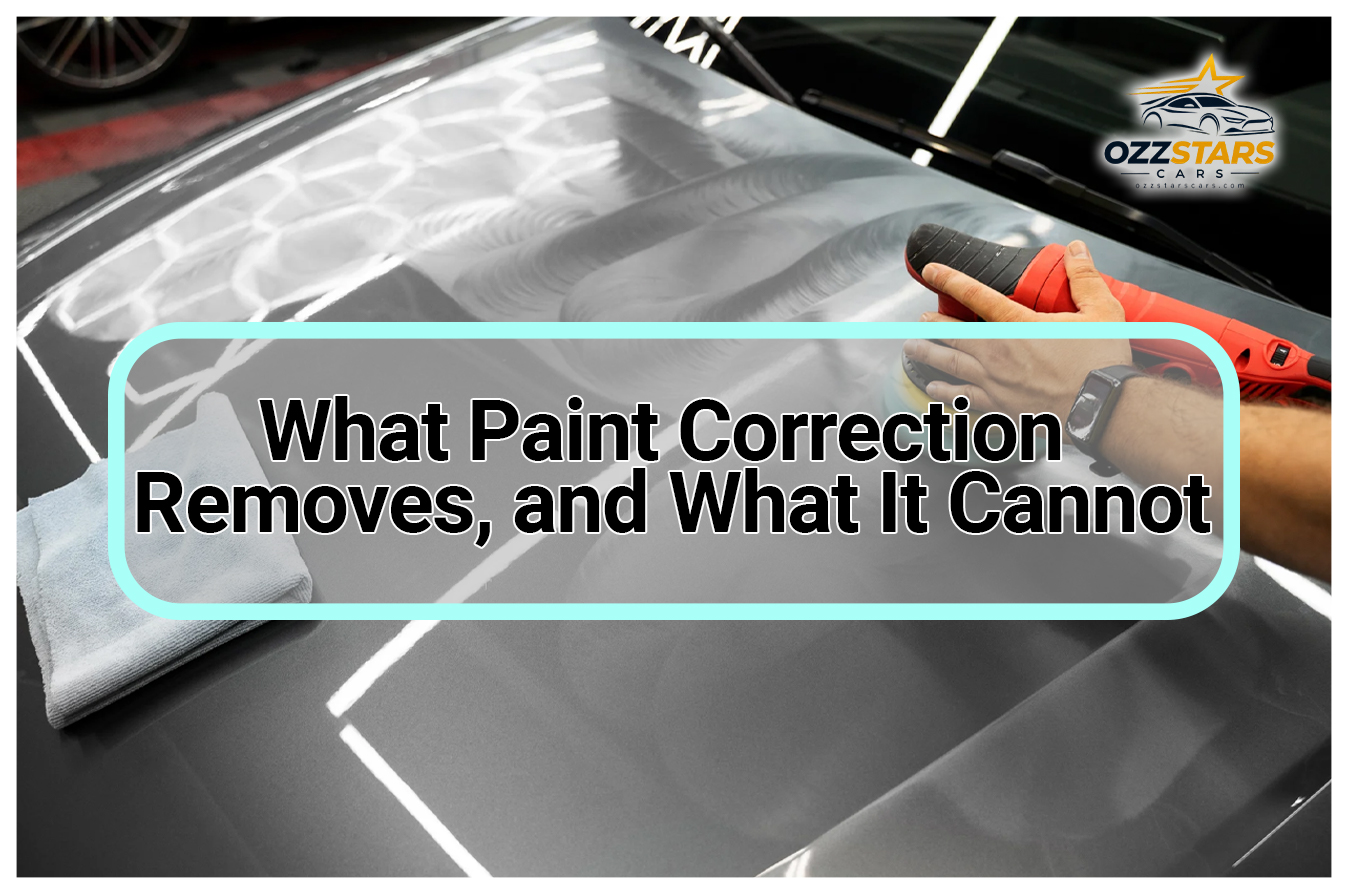
What Paint Correction Removes, and What It Cannot
Correction does not take the scratch out of the paint. It takes the paint down to the bottom of the scratch.
Read that twice. It is the whole subject, and once you have it, every quote you receive and every result you see makes a different kind of sense.
We have not performed paint correction and this page does not claim to. What follows is documented mechanism, stated as mechanism.
What a swirl or a scratch physically is
A defect in the clear coat is a groove or a valley. Light hits the walls of that valley and scatters, which is why swirls appear as a halo around a point light source and vanish in flat, diffuse daylight.
To make the valley stop scattering light, you have two options.
Fill it, so that the surface is optically flat again. That is what a glaze does, and it is temporary because the filler washes out over a few weeks of washing.
Remove the material around it until the surface is level with the bottom of the valley. That is correction, and it is permanent because the material is gone.
There is no third option. Nothing removes a scratch while leaving the surrounding paint intact, because a scratch is an absence rather than a presence.
Which means the deeper the defect, the more paint it costs
A shallow swirl costs a small amount of clear coat. A deep scratch costs a lot. And a scratch deeper than the clear coat cannot be corrected at all, because levelling to its bottom would mean removing the entire clear layer and cutting into the color underneath.
That is the actual meaning of "it cannot be buffed out". Not that the technician is unwilling, but that the arithmetic does not work.
The test people use to estimate this is a fingernail across the defect, and it has its own article on this site.
What correction does remove
Swirl marks and wash marring. The fine circular scratching that comes from washing and drying, which is the most common thing anyone books correction for. How it got there is worth understanding before you pay to have it removed, because the same routine will put it straight back, and that is set out in how swirl marks actually happen.
Light scratches within the clear coat.
Water spot etching, where mineral deposits have etched into the surface, if the etching is shallow enough.
Oxidation and dullness, where the top of the clear coat has degraded but the layer is still substantially intact.
Holograms and buffer trails from previous badly done machine work.
What it cannot remove
Anything through the clear coat. Color showing, or primer, or metal.
Stone chips. These are impacts, not scratches, and they have gone through. Correction around a chip removes clear coat and leaves the chip.
Dents of any kind. Correction acts on the surface, not on the shape.
Failed clear coat. Where the clear layer has begun to peel or has gone chalky through, there is nothing to level. Correcting it removes what is left and accelerates the failure.
Anything on a surface that is not paint. Trim, glass and plastics are different materials with different rules.
Why every page ranking on this query says yes
Search this and look at who is answering. In the SERP checks recorded when this site's topical map was built, dated 2026-08-22 and kept in this site's own evidence file, the pattern across the paint protection queries was consistent: the ranking results were coating installers, detail shops and chemical brands, and each installer page concluded that the work was worth doing and ended in a booking form.
That unanimity is a finding about the sellers rather than about the product. It is not an accusation that any of them is wrong. It is the observation that none of them can afford to write the sentence "your car probably does not need this", and that we can, because nothing on this site takes a booking.
So here it is. Most daily drivers do not need full correction. What most daily drivers need is to stop creating swirls, which is free, and which is the entire subject of this site's first cluster.
The honest sequence, cheapest first
1. Fix the wash. If your routine is putting swirls in faster than correction removes them, correcting is a subscription rather than a repair. Two buckets, the right media, straight lines, and the drying step, which is where a great deal of marring actually happens and is covered in how to dry a car without scratching it.
2. Decontaminate. Some of what looks like a defect is contamination sitting on top, and it comes off without spending any paint at all. The test is a thin plastic bag over your fingertips on washed, dried paint, checking the horizontal panels first, because fallout lands where gravity puts it.
3. Look at the paint in the right light and decide what actually bothers you. Direct sun, or a single strong light source in a dark space. A great many cars look worse under inspection light than they do in life.
4. Try the least aggressive option on a test area. Polish before compound, always.
5. Only then consider paying for correction, and go in knowing what you are buying: not new paint, but less of the paint you have, arranged more flatly.
6. Protect afterwards, and change the wash routine, or you will be back.
What we will not publish
No stage counts. "One-stage" and "two-stage" mean different things to different shops and the terms are not standardized.
No percentage of defects removed. Any figure like that is an estimate about a specific car by someone looking at it.
No clear coat thickness in microns and no depth-gauge readings. Publishing one invites arithmetic about how many corrections a car has left, and that depends on the vehicle, the paint, the history and any previous work. A wrong number here costs the reader a repaint.
No price. It depends on the car, the condition and the market, and a figure would be invented.
No claim about what any product or machine achieves. We have tested none.
FAQ
What is paint correction?
The removal of clear coat down to the level of a defect, so the surface is flat again and no longer scatters light. It does not lift a scratch out; it takes the surrounding material down.
Does paint correction damage your paint?
It removes clear coat, which is finite and is only replaced by a repaint. That is the trade rather than a side effect, and it is why the least aggressive approach that works is the right one.
Will paint correction remove all my scratches?
Only those within the clear coat and shallow enough to level to. Anything through the clear coat, and any stone chip, cannot be corrected.
How often can a car be corrected?
There is no number that applies generally, because it depends on the paint, the vehicle and what has already been done to it. What is true generally is that the resource is finite, which is a good reason to prevent defects rather than to remove them repeatedly.
Is paint correction worth it?
Every page ranking on that question in the checks recorded on this site's map on 2026-08-22 was written by someone who takes bookings. Our answer is that fixing the wash routine comes first, because correction on an unchanged routine is a recurring cost rather than a repair.
Sources: the SERP composition described above is from this site's own recorded topical-map evidence, dated 2026-08-22 and held in this site's archive. It is first-party research by this site, not a claim about any named business.
This page names no product, no machine, no price, no stage count, no abrasive grade, no grit number and no clear coat thickness figure. It publishes no tire pressure, tread depth, torque value, wheel load rating or load index, which is a standing rule on this site.
No paint correction has been performed for this page and nothing here is presented as a test result. The optical and material mechanisms described are general coatings and detailing knowledge stated as such.