Straight Lines vs Circles: What Causes Swirl Marks
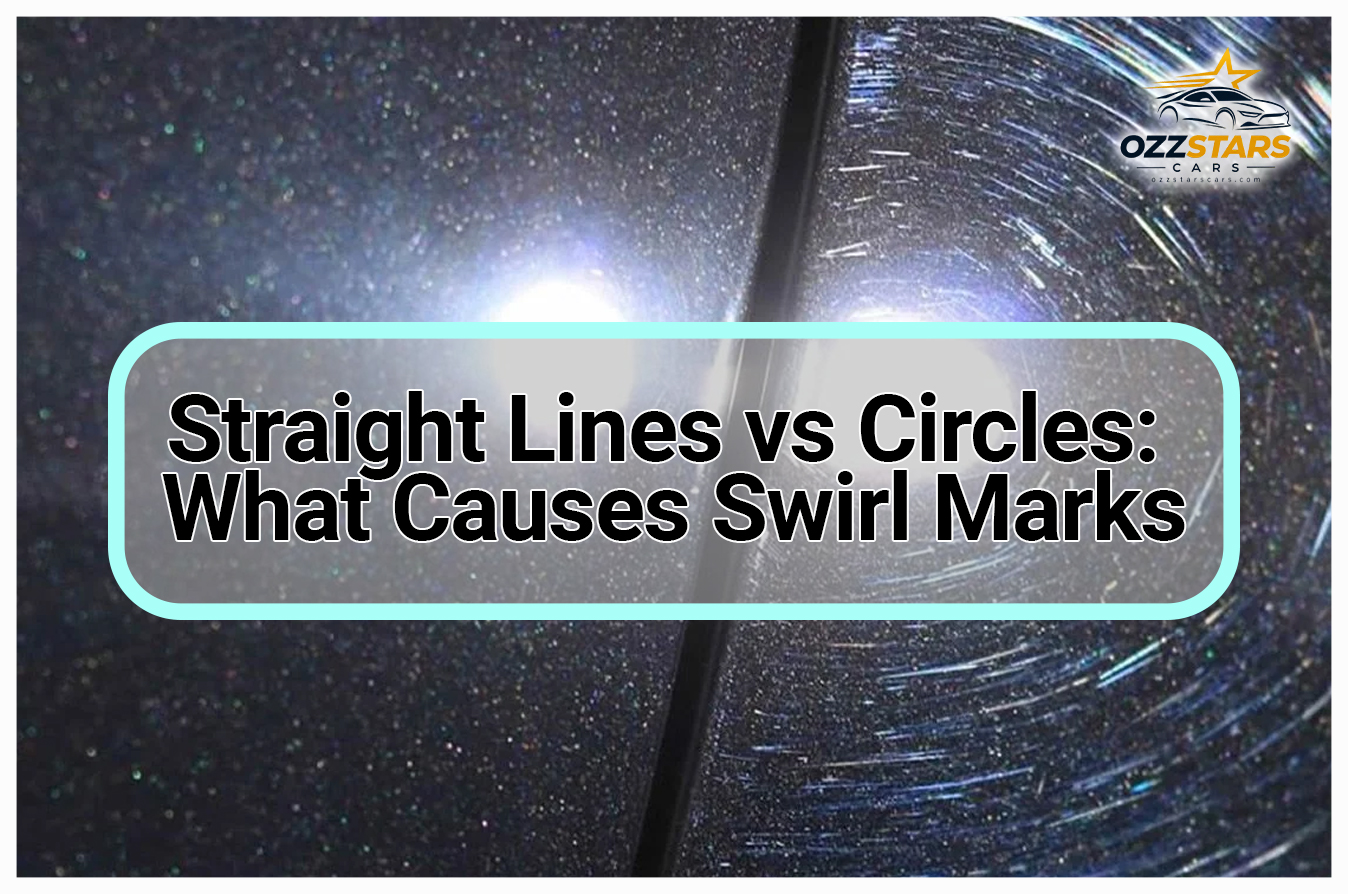
Yes, the direction a mitt moves genuinely matters. Wiping in straight, overlapping lines carries any trapped grit past a point once, while scrubbing in circles grinds the same particle back and forth across the same small patch of paint repeatedly, which is exactly the interlocking, web-like scratch pattern that gives swirl marks their name. Motion is not the only factor in avoiding swirl marks, but among the habits that cost nothing extra to change, it is one of the most direct.
Why circular motion produces a recognizable pattern
A swirl mark gets its name from what it looks like under bright, angled light: a dense web of fine, overlapping arcs. That pattern is a direct fingerprint of circular scrubbing. When a mitt moves in circles, any particle trapped against the paint gets dragged along a curved path and then dragged back over nearly the same curve on the return stroke. The same small area of paint absorbs repeated passes from the same grain of grit, cutting a series of tiny curved scratches that overlap into the swirl pattern.
A straight, single-direction wipe does the opposite. A trapped particle gets carried in one line, then the mitt moves on to the next section. The particle is not repeatedly dragged back across the same spot. It still causes a scratch if it was abrasive enough, but the scratch is a single line rather than a repeated arc, and it is far less visually obvious and far less concentrated in one area.
How this fits with everything else that reduces grit
Motion does not replace the other habits that keep grit off the paint in the first place. A pre-rinse removes loose material before the mitt arrives, covered in Why You Rinse Before the Mitt Ever Touches the Paint, and the two-bucket method keeps the mitt from reloading itself with grit mid-wash, covered in The Two-Bucket Method, and What It Actually Prevents. Straight-line motion is what happens with whatever grit survives both of those steps. Fewer particles reaching the mitt means motion matters less; more particles reaching the mitt means motion matters more. They work together, not as substitutes.
How to actually apply straight-line washing
Work each panel in one consistent direction, front to back or side to side, rather than scrubbing back and forth in a scribbling motion. On flat, horizontal surfaces like the hood, roof, and trunk lid, a front-to-back pass generally follows the car's own panel lines. On vertical surfaces like doors and fenders, a top-to-bottom or front-to-back pass works the same way. The specific direction matters less than the consistency: pick a line and carry the mitt through it without doubling back over the same section repeatedly.
Does pressure matter as much as direction
Pressure and direction both affect how hard a trapped particle gets pressed into the paint, and they interact. Light, even pressure combined with straight-line motion minimizes both the force on any trapped grit and the number of times it crosses the same spot. Heavy pressure in straight lines is still safer than heavy pressure in circles, because the particle still only crosses a given point once rather than repeatedly, but light pressure is the better instinct regardless of direction. Straight-line motion is the change that matters most for the swirl pattern specifically; pressure control is a separate, complementary habit.
Where the mitt itself comes into this
Motion only controls how a trapped particle moves across the paint. It does not control whether the mitt is holding grit in the first place, or how readily it lets that grit go when rinsed. A wash medium that traps grit deep in dense fibers and releases it poorly will keep re-depositing material onto the paint regardless of how carefully the mitt is moved. That side of the mechanism, pile depth, material, and how a mitt rinses out, is covered in Mitts, Sponges and Wash Media: What Holds Grit and What Releases It.
Does this apply to drying too, not just washing
The same logic, straight motion over repeated circular motion, generally applies to any stage where a tool is dragged across paint under contact, including drying. This guide is specifically about the washing stage; drying technique is its own topic with its own set of risks around towel type and how a car is dried after the water itself is removed.
What straight-line motion cannot fix
Motion reduces how badly a trapped particle scratches the paint. It does not eliminate the scratch entirely if the particle is genuinely abrasive, and it does nothing about grit that was never removed in the first place. It is one part of a chain of habits, not a stand-alone fix, and it works best combined with a thorough pre-rinse, clean wash water, and a mitt that actually releases what it picks up.
FAQ
Does the direction I wipe in actually matter, or is this just detailer superstition?
It matters mechanically. A trapped particle dragged in a straight line crosses a given point once; the same particle dragged in a circle crosses the same point repeatedly, which is why circular motion produces the characteristic overlapping-arc swirl pattern.
Is front-to-back or side-to-side the correct direction?
Either works. The important part is consistency, one direction per pass, rather than which specific direction is chosen.
Does light pressure matter as much as straight lines?
Both matter and they work together. Straight-line motion mainly reduces how many times a trapped particle crosses the same spot; light pressure reduces how hard it gets pressed in each pass.
Will straight-line washing completely prevent swirl marks?
No single habit does. It significantly reduces the visible, web-like swirl pattern specifically, but it works together with a pre-rinse, clean wash water, and a mitt that releases grit rather than holding it.
Does this apply to washing wheels too?
Wheels typically carry heavier, more bonded contamination like brake dust, and are usually washed with separate tools from the paint entirely, so the same straight-line logic applies but within a different overall process.