How to Dry a Car Without Scratching It
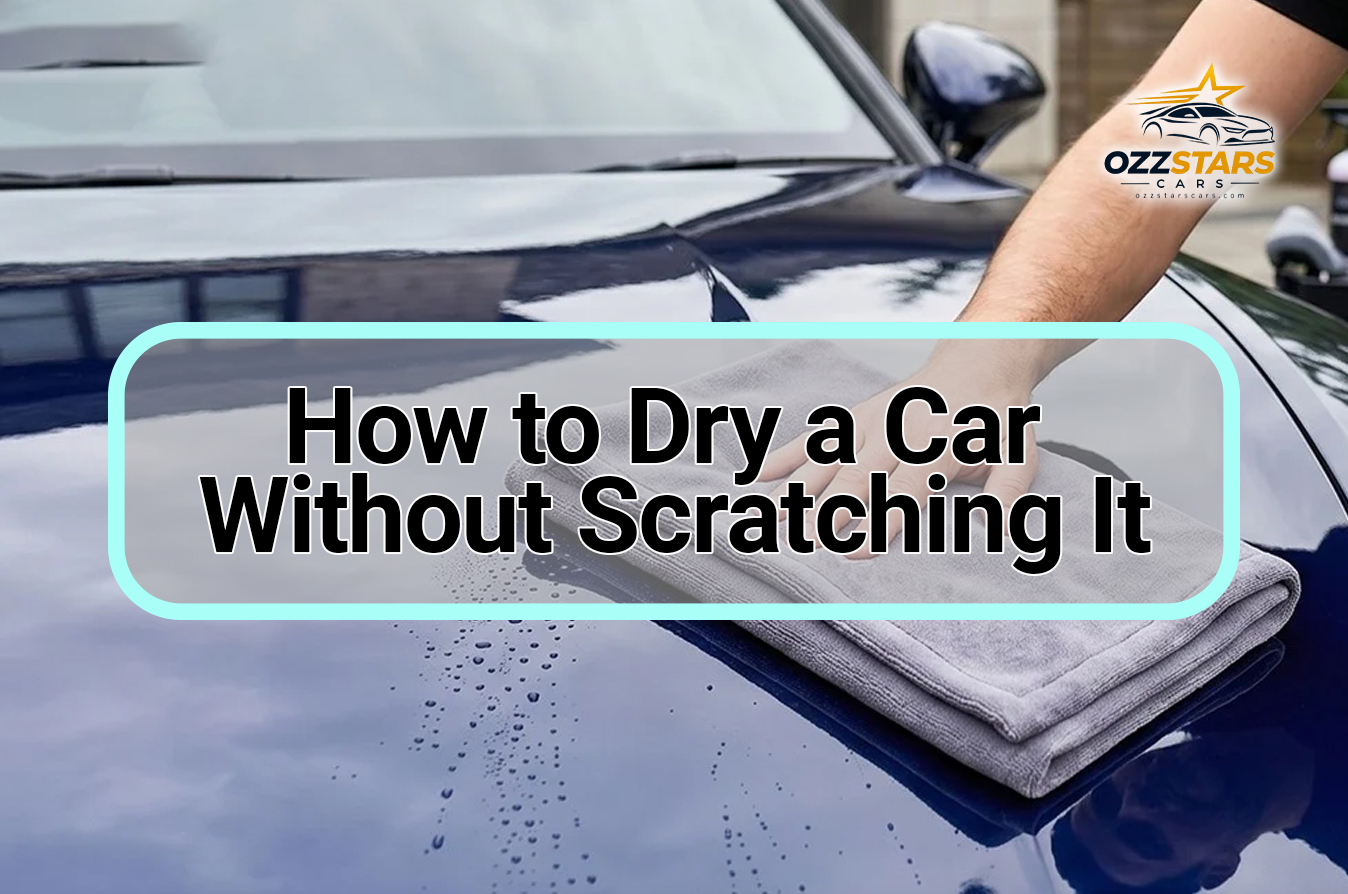
Use a clean microfiber towel and blot the water off, do not drag the towel across the paint. Blotting lifts a trapped particle away after one point of contact. Dragging keeps that same particle pressed against the clear coat while it travels several inches, which is the same friction that causes swirl marks during the wash itself. Fold the towel in quarters so you always have a clean, dry face against the paint, work from the top of the car down, and remove as much standing water as possible with a light air pass before the towel ever touches a panel. Drying is where a careful wash gets undone, and the fix is not a softer towel. It is less contact, held for less time, with less pressure.
Why dragging causes scratches and blotting does not
A wash mitt loaded with grit is sandpaper, covered in How to Wash a Car Without Putting Swirls Into It. A drying towel works the same way. Water left on a car after a rinse is not just water. It carries whatever loose dust, pollen, or road film the rinse did not fully remove, plus any residue from the wash itself. If a towel is dragged across that surface, a trapped particle stays in contact with the clear coat for the whole length of the pass, the same as a mitt scrubbed in circles. If the towel is pressed down and lifted straight back up, that same particle gets one moment of contact instead of a long one, and the towel comes away with it rather than pushing it forward across the paint.
This is the entire reason detailers use the word "blot" instead of "wipe." It is not a texture preference. It describes a motion with less total friction per particle, which is the same principle behind straight-line washing over circular scrubbing, covered here.
Reduce the water before the towel has to
The less water a towel has to remove by contact, the less contact it needs. A quick pass with a purpose-built air mover, before any towel touches the car, clears the bulk of standing water off flat panels and blows it out of mirrors, badges, trim, grilles, and panel gaps where a towel struggles to reach anyway. That means fewer towel passes are needed afterward, and fewer passes means fewer chances for a trapped particle to matter.
This is not a requirement. A towel alone, used correctly, dries a car safely. But every pass a towel does not have to make is a pass that cannot introduce a scratch, which is why professionals lean on air first where the equipment is available.
Technique that keeps the risk low
- Fold in quarters. A towel folded this way gives eight clean faces before it needs rinsing or swapping, instead of one face getting reused, picking up more grit with every pass.
- Work top-down. The roof and upper panels usually carry the least road grime, covered in the wash-order logic in Top-Down Wash Order, and Why the Bottom Panels Come Last. Drying in the same order means a towel is not dragging debris from a dirty lower panel up onto paint that is already dry.
- Swap faces often. The moment a face of the towel has done real work, on a hood or a door with visible grime, move to a clean quarter rather than continuing on the same one.
- Light pressure only. Enough to lift water, not enough to press anything trapped in the towel against the paint.
What actually loads a towel with grit mid-dry
Two things ruin an otherwise correct drying routine. The first is a towel dropped on the driveway or garage floor and picked back up without a real rinse. Whatever was on that surface is now in the towel, and no amount of careful blotting afterward corrects for it. The second is starting the dry on the dirtiest part of the car, a lower rocker panel or a bumper, and then continuing upward with the same towel face, carrying that grit onto cleaner paint. Working top-down and starting with a clean towel avoids both.
Panel temperature changes the stakes
Drying matters more on a warm panel than a cool one. Water left sitting on hot paint does not just sit there, it starts to evaporate, and shampoo residue or mineral content in the water can dry onto the clear coat before a towel gets to it, which is a separate problem from a scratch. That mechanism, and why it matters more than most readers assume, is covered in Washing in Direct Sun: What Actually Goes Wrong. The practical takeaway here is that speed matters more on a hot day, which is one more reason an air pass before the towel helps: it shortens the window water has to sit and dry in place.
There is more than one reasonable way to combine air and towel, and which combination makes sense depends on the equipment on hand and how the car was just washed. That comparison, blower versus blot versus drag, is worked through directly in Blowing, Blotting or Dragging: Three Drying Methods Compared.
What towel actually matters here
Not every microfiber towel behaves the same way once it has water and residue in it. Pile depth, weave, and how worn the towel is all change how safely it can be dragged across paint, or how forgiving it is if a pass is not perfectly executed. That distinction, and the more useful question of when a towel has been used enough that it should stop touching paint at all, is covered in Microfiber: Weave, Weight and When to Retire a Towel.
What careful drying cannot fix
Drying correctly prevents new scratches from the drying step itself. It does not correct swirl marks already in the paint from a previous wash, a drive-through, or a towel that got dropped once and used anyway. That is a correction and polishing question, not a drying-technique one, and this guide does not claim to solve it.
FAQ
Is air-drying without any towel safer than using one?
Not automatically. Letting water sit and evaporate on its own avoids towel contact entirely, but it trades that risk for water spots, especially on a warm panel or in hard-water areas, since minerals in the water are left behind as it dries in place rather than being lifted away.
Does the type of microfiber towel matter as much as the technique?
Both matter, but technique comes first. A high-quality towel dragged across paint can still scratch it. A basic towel used with a proper blotting motion is far safer than a premium towel used carelessly.
How many towels do I actually need to dry a car properly?
One large towel, folded in quarters and used correctly, can dry most of a car. Having a second on hand helps for the lower panels and wheels, which should stay separate from whatever touches the paint above them.
Can I use a bath towel or a regular cotton cloth instead of microfiber?
Cotton fibers are coarser and less able to lift and hold water and particles the way microfiber does, which increases the amount of dragging friction for the same amount of drying. Microfiber is the safer choice for this reason, not brand preference.
Does it matter if the car air-dries partway before I get to it with a towel?
Yes. The longer water sits, especially on a warm panel, the more time it has to start drying in place and leaving mineral or residue spots behind. Drying promptly after the final rinse reduces that window.