Touchless vs Hand Wash: What Each Does to Your Paint
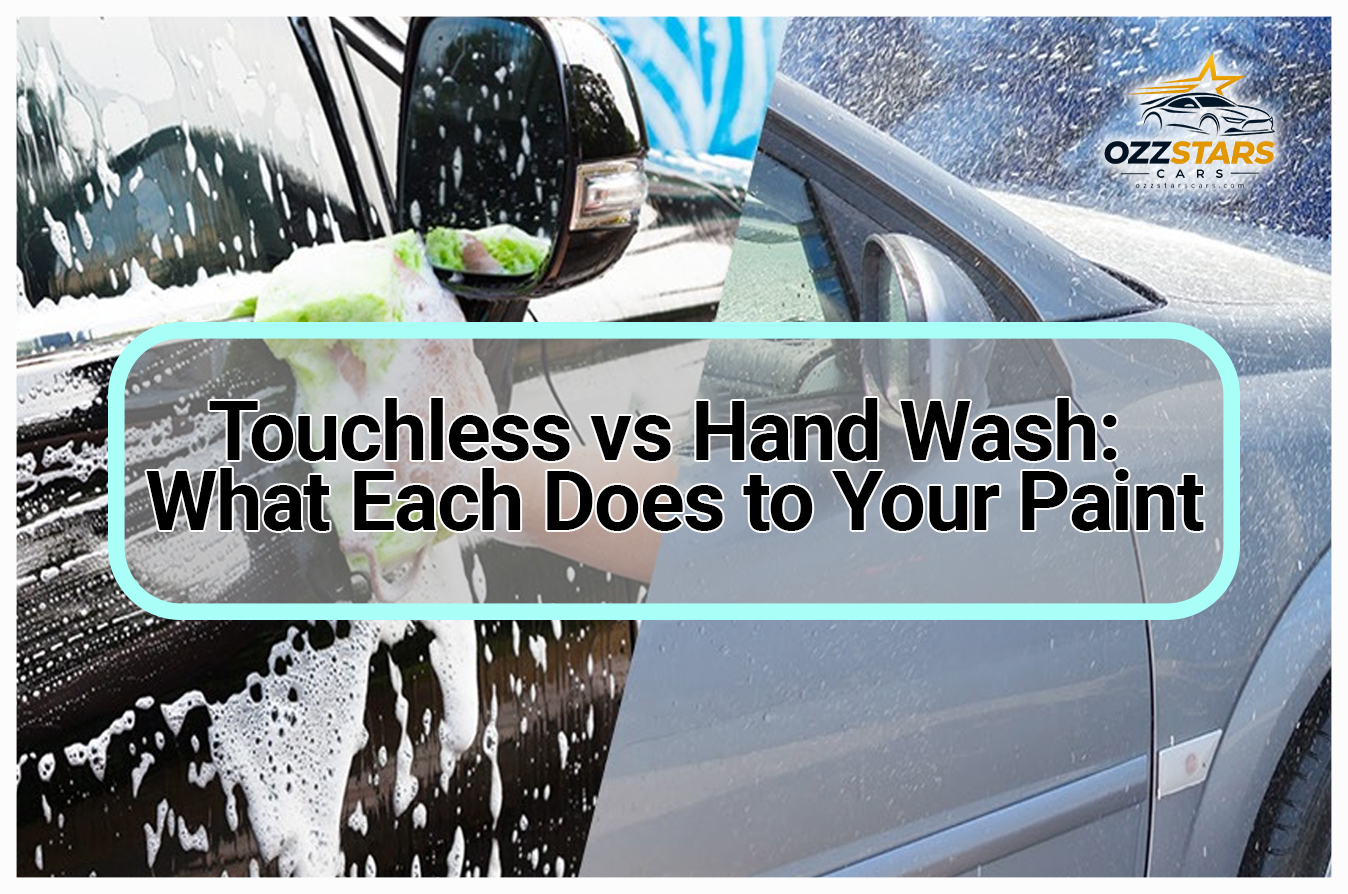
There is no flat winner between touchless and hand washing. Touchless avoids the contact that drags grit across paint, but it relies on stronger detergent chemistry to do that job, and repeated exposure to that chemistry wears down wax and sealant faster than a gentle hand wash would. Hand washing done correctly, with a two-bucket setup and clean tools, is gentle on protection but genuinely risky when done carelessly, because a gritty mitt is the single biggest cause of the fine scratches called swirl marks. Which one is better for a given car depends on which failure mode you are more likely to actually have: careless hand technique, or frequent exposure to aggressive chemistry.
Three options, not two
Most comparisons frame this as touchless versus hand wash, which skips the option that carries the most risk of all: soft-touch, sometimes marketed as "touchless" even though it is not.
- True touchless uses only water pressure and detergent chemistry to lift dirt off the car. Nothing physically contacts the paint at any point.
- Soft-touch (brush or cloth-strip tunnels) uses foam brushes or cloth strips that physically wipe the car, mechanically similar to hand washing, except the material has already brushed dozens of other cars that day and is not rinsed clean between them the way a home mitt should be.
- Hand washing uses a mitt and bucket under the washer's own control, the same two-bucket setup a careful home wash relies on, for better or worse.
Soft-touch is the one most likely to embed grit and drag it across paint, for the same reason a dirty mitt does at home, just at a larger scale and out of the customer's control. If a facility advertises "touchless" but the bay clearly has spinning brushes or hanging cloth strips, it is soft-touch, not touchless, and it carries hand-wash-level contact risk without hand-wash-level control over cleanliness.
What touchless actually does to paint
A true touchless wash has a genuine mechanical advantage: nothing physically touches the car, so there is no mitt, brush or towel to drag a piece of grit across the clear coat. That advantage is real and it is the reason touchless exists at all.
The trade-off is chemistry. Because there is no physical agitation to help lift dirt, touchless systems lean on stronger, higher-pH detergents to break the bond between grime and the paint surface, as reported by detailing industry sources. That chemistry is effective at its job, but it is also harder on wax and sealant than a milder pH-balanced car shampoo, and repeated exposure over many washes degrades a protective layer faster than gentle hand washing with the right product does. A car that gets touchless-washed every week with no reapplied protection will typically need wax or sealant renewed more often than one hand-washed with the same frequency.
What hand washing actually does to paint
Hand washing, done with a two-bucket setup, a clean mitt, and straight-line motion, is genuinely the gentlest option on protective coatings, because there is no aggressive chemistry doing the lifting. The soap only needs to be mild enough to break the bond between light dirt and paint, since the mitt and rinse water are doing the rest of the work mechanically.
The honest problem is that "done correctly" is carrying a lot of weight in that sentence. A mitt that picked up grit from a dirty wash bucket, or was dropped on the ground and not rinsed, is functionally sandpaper, and dragging it across the paint is the single most common cause of the fine, criss-crossed scratches called swirl marks. The full mechanism, and every habit that interrupts it, is in How to Wash a Car Without Putting Swirls Into It.
The honest comparison, side by side
| Touchless | Hand wash (done correctly) | Soft-touch (brush tunnel) | |
|---|---|---|---|
| Contact risk to paint | None | Low, if the mitt and bucket are kept clean | Highest, since shared brushes carry grit between cars |
| Chemistry harshness | Higher-pH, stronger detergent needed | Mild, pH-balanced shampoo is sufficient | Similar to touchless, plus contact |
| Effect on wax and sealant over repeated washes | Wears down faster | Gentlest on protection | Wears down fastest of the three |
| Main risk if done poorly | None mechanical, only chemical wear | Swirl marks from a gritty mitt | Both chemical wear and swirl-style marks |
| Best fit | No time or tools for hand washing, and protection is reapplied regularly | Time and tools available, protection matters | Avoid where possible |
If your paint already has swirl marks
A car with existing swirl marks is not made worse by switching to touchless in the short term, since there is no contact involved, though the chemistry trade-off on wax and sealant still applies. Switching a heavily swirled car to hand washing only helps once the technique is genuinely careful and consistent, since a hand wash performed with the same habits that caused the swirl marks in the first place, a dirty mitt, a poor rinse, no two-bucket setup, simply keeps adding them. Neither option corrects marks that already exist. That correction is a separate, dedicated process, not a byproduct of choosing a gentler wash method going forward.
So which one should you actually pick
Neither is universally better, and any article claiming otherwise is oversimplifying a real trade-off. A reasonable way to decide:
If you have the time, a bucket, mitt and clean microfiber towels, and you keep wax or sealant on the car, hand washing protects the finish better over time, provided the technique stays careful every time, not just most of the time. If you do not have that setup, or you wash more often than you can realistically do it right, a true touchless wash avoids the single biggest risk of careless hand washing, contact-based scratching, at the cost of needing to reapply protection more often. Avoid soft-touch brush tunnels where a genuine touchless or a careful hand wash is available, since it carries the downsides of both without the advantages of either.
For a reader with no hose or driveway at all, the practical middle ground, rinseless and waterless washing, is covered in Washing a Car With No Driveway and No Hose.
What neither option fixes
Neither touchless nor hand washing corrects swirl marks or contamination that is already in the paint. Both are maintenance methods, and choosing the gentler one going forward does not undo damage from years of a brush tunnel or a careless mitt. That correction is a separate process entirely, and no wash method, however careful, substitutes for it.
FAQ
Is touchless car wash bad for paint?
Not mechanically, since nothing touches the car. The trade-off is chemical: touchless relies on stronger detergent to do the job contact would otherwise do, and that chemistry wears down wax and sealant faster with repeated use.
Is hand washing always safer than touchless?
Only when done correctly, with clean tools and careful technique every time. A careless hand wash with a gritty mitt causes more damage than a well-run touchless system.
What is soft-touch, and is it the same as touchless?
No. Soft-touch uses brushes or cloth strips that physically contact the car, often on many vehicles per day. It carries hand-wash-style contact risk without the cleanliness control a home wash allows.
Which one is gentler on a ceramic coating?
Hand washing with a mild, pH-balanced shampoo is generally gentler on a coating than repeated touchless washes, because touchless relies on stronger chemistry to compensate for having no physical contact.
How do I tell if a "touchless" wash near me is actually soft-touch?
Look at the bay itself. Spinning foam brushes or hanging cloth strips mean physical contact, whatever the sign says. A genuine touchless bay uses only water jets and foam application, with nothing that physically touches the car.