How to Wash a Car Without a Hose in an Apartment
No hose and no driveway does not mean no wash. A rinseless wash, done with a bucket of diluted solution and clean microfiber towels, can clean a genuinely dirty car with no running water at all. A waterless wash, sprayed straight from a bottle and wiped off, works only on light dust and pollen. Both avoid a hose entirely, and both avoid the two problems an apartment lot actually creates: nowhere to run water and, in some buildings and cities, rules against letting wash water reach a storm drain. Neither is a shortcut for a heavily soiled car. That is the one honest limit worth knowing before you buy the bottle.
The two real options, and what separates them
Apartment dwellers usually find the same two products recommended, often lumped together as if they are interchangeable. They are not.
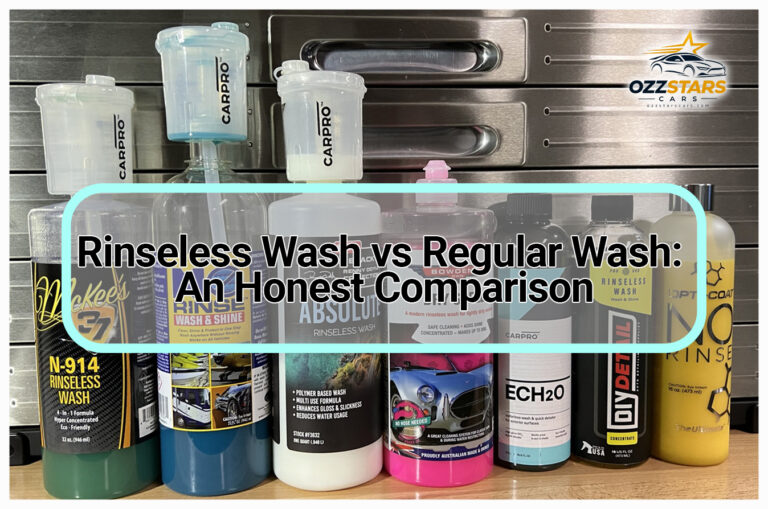
A rinseless wash is a solution mixed at a specific dilution into a full bucket of water, then applied with a mitt or wash media and lifted away with microfiber towels. The diluted solution carries the same lubricating and encapsulating job a hose rinse normally does, so grit suspends in the towel and solution instead of grinding against the clear coat. Because there is a full bucket of lubricated liquid doing that work, a rinseless wash can handle real road film, dust and moderate grime, not just a light coating.
A waterless wash is a spray-on product wiped off with a dry-ish microfiber towel, with no bucket step at all. There is far less lubricant in a thin sprayed film than in a full bucket, so it holds up on light dust and pollen only. Used on anything dirtier, the towel is dragging grit across the paint with almost nothing to cushion it, which is precisely the mechanism that puts fine scratches into a clear coat.
The full mechanism behind both, and why grit dragged across paint (not the wash itself) is what causes swirl marks, is covered in How to Wash a Car Without Putting Swirls Into It.
How dirty is too dirty for either one
This is the question an apartment dweller actually needs answered, because it is also the situation where these methods are tempting the most: the car has been sitting in a lot for weeks and looks genuinely bad, not lightly dusty.
| Condition of the car | Honest answer |
|---|---|
| Light dust, pollen, a week or two since the last wash | Waterless wash is appropriate |
| Visible road film, moderate everyday grime | Rinseless wash, with a bucket, frequent towel changes, and patience |
| Caked mud, heavy salt buildup, visible grit you can feel with a fingertip | Neither is safe. This is exactly the situation where a hose-and-bucket wash, or a trip to a touchless bay, is the right call |
That last row matters more for an apartment dweller than for anyone else, because it is the exact moment the car has gone too long without a proper wash and rinseless technique looks like the obvious answer. It is the one condition where reaching for a rinseless bottle instead of a real rinse increases the risk it exists to prevent. The full comparison, including why rinseless tolerates more dirt than waterless, is in Rinseless and Waterless Washes: When They Are Honest Options.
The lot itself has rules, even if nobody told you
This is the part most guides skip entirely, and it is the actual first question for anyone parking in a shared lot. Many apartment complexes have lease clauses against washing a car on the property at all, independent of method, because wash water carrying soap and road grime runs off the pavement toward a storm drain rather than a treatment system. Some municipalities restrict or prohibit exactly that, since storm drains typically discharge to local waterways untreated. Before setting up a bucket in a parking spot, it is worth checking the lease and, if unsure, the city's own storm-water rules rather than assuming a quiet corner of the lot is fine because nobody is watching. Rinseless and waterless washing sidestep this concern almost entirely, since there is no runoff stream to manage, which is part of why they are the honest answer for this situation and not just a workaround.
Setting up in a space you do not control
A few habits make either method work better in a lot that was not built for washing a car:
- Park in shade, or wash early or late so panels are not hot to the touch. A hot panel flashes wash liquid dry before it can lift grit, which forces extra rubbing exactly where you do not want it.
- Bring more towels than feels necessary. Eight to ten for a rinseless wash, six to eight for waterless, so a fresh, clean side is always available instead of reusing a towel that already picked up grit.
- Work one panel at a time, folding each towel to a clean quadrant before it goes back to a dirty panel. This is the same principle behind the two-bucket method, explained here, applied without a bucket at all: never let a tool that already picked up grit touch the paint again.
- A trunk organizer or small caddy keeps solution, towels and a spray bottle from rolling around, which matters more in a lot than a driveway since there is no flat staging area nearby.
A self-serve bay is the other real option
For a car that has gone past what rinseless or waterless can handle, a coin-operated self-serve bay is worth considering alongside a full touchless facility, and it is often nearby even without a home driveway. Self-serve bays typically offer a high-pressure wand cycle, a foam-brush cycle, and a rinse cycle, selected in sequence for a set number of minutes per token or coin. The wand cycle itself is contact-free and behaves similarly to a touchless wash, while the foam-brush attachment physically touches the car and carries the same shared-contact risk as any brush system, since it has already brushed other vehicles that day. Using the wand and foam-soap settings while skipping the brush attachment, then finishing with the plain rinse cycle, gives an apartment dweller real water pressure and a proper rinse without needing a personal hose, a driveway, or the contact risk that comes with the brush.
What neither method replaces
Rinseless and waterless washing are real methods within their dirt range, not a lesser substitute for "a real wash." But neither corrects existing swirl marks or restores paint that already looks hazy, and neither is a substitute for a proper rinse and hose wash on a car that has gone past light-to-moderate dirt. An apartment dweller who genuinely cannot manage a heavily soiled car with either method is better served by a touchless wash bay or a self-serve wand cycle for that one occasion, covered in Touchless, Soft-Touch and Hand Wash: What Each Does to Paint, than by forcing rinseless technique past its limit.
FAQ
Can I really get a car properly clean with no hose at all?
Yes, within the dirt range each method is built for. Rinseless handles real road film and moderate grime; waterless handles light dust and pollen. Neither is a compromise when matched to the right level of dirt.
Is it legal to wash a car in an apartment parking lot?
It depends on the lease and the municipality. Many complexes restrict washing on the property, and some cities regulate wash water reaching storm drains. Check both before setting up, rather than assuming it is fine.
What if my car is too dirty for rinseless washing?
That is the one condition where neither rinseless nor waterless is the safe choice. A hose-and-bucket wash, a touchless bay, or a self-serve wand cycle is the better option for that particular wash, even if rinseless is the usual routine.
Do I need special towels for a no-hose wash?
Clean, well-maintained microfiber towels matter more here than with a hose wash, since there is no running water to help flush extra grit along. Bring more than seems necessary and rotate to a clean side often.
Is a waterless wash the same thing as a rinseless wash?
No. A rinseless wash uses a bucket and can handle real dirt. A waterless wash is a spray-and-wipe product limited to light dust and pollen, with no bucket step.