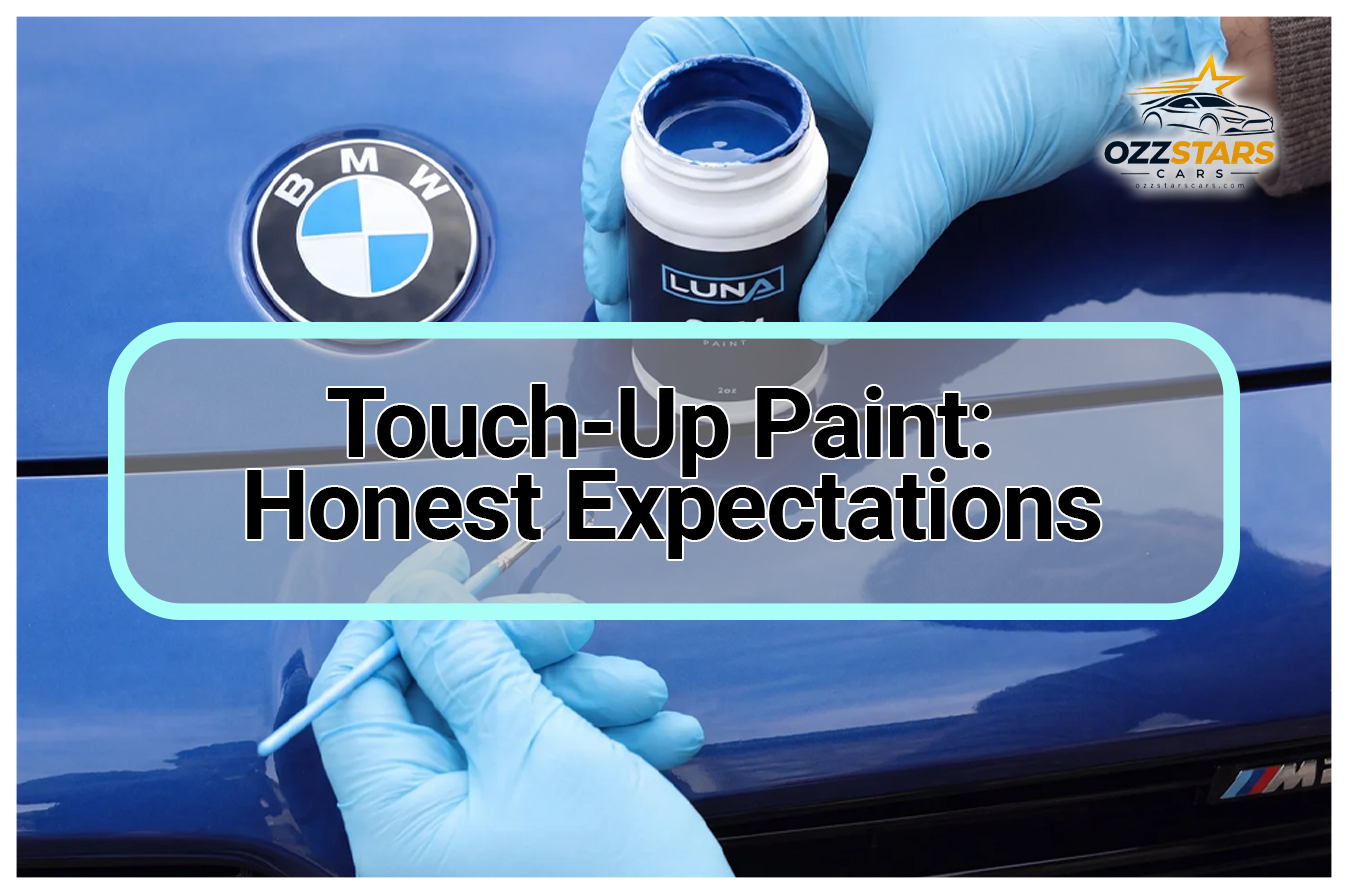
Touch-Up Paint: Honest Expectations
Will it look repaired, or will it look worse than the chip?
Both are possible, and which one you get depends less on the product than on what job you think you are doing.
The reframe that makes this work
Touch-up paint is corrosion protection that happens to be colored.
That is the honest description. Its job is to put a barrier between steel and weather. The fact that it is your car's color is what makes the barrier acceptable to look at rather than what the barrier is for.
Judged as corrosion protection, it works and it is worth doing.
Judged as invisibility, it fails, and it will fail every time, on every car, with every product, applied by anyone. That is not a criticism of any product. It is the geometry of the situation, and it is below.
Why it cannot be invisible
A chip is a small crater with a hard edge. To make it disappear you would need to fill it exactly level with the surrounding surface, with a material of exactly the same color and exactly the same optical depth, and finish it flush with the same gloss.
Three of those four are effectively impossible by hand.
Level. Paint applied into a crater either sits low, leaving a visible dip, or sits proud, leaving a visible lump. Proud is what almost everyone produces, because it is what a brush or a pen does.
Color match. Factory paint fades and shifts with sun exposure. A paint code matched to the car as built is matched to a car that no longer exists. The match is closest on a young car and a garaged one, and it is genuinely good on some colors and genuinely poor on others, with metallics and pearls being harder because the metal flake orientation in a brushed application does not match a sprayed one.
Gloss. Factory finish is clear coat sprayed and leveled. A dab of paint dried in a crater is neither.
So the realistic best outcome is a chip you have to look for instead of one you notice, and that is a good outcome rather than a compromise.
When it is genuinely worth doing
When bare metal is showing. This is the case that justifies it regardless of appearance. Unprotected steel corrodes, and rust travels under the paint around the chip, so a chip left through a wet season becomes a much larger repair than the chip was.
On a car you are keeping. The benefit compounds.
On chips in the impact zones, the leading edge of the hood, the front bumper, the mirror faces, the area behind the wheels, where they cluster.
Before winter, in a climate with road salt.
When it is not
On a scratch rather than a chip. A long thin scratch touched up by hand produces a raised line of paint along its length, and a line is far more visible than a dot. This is the single most common way people make things worse.
When your fingernail glides over it and no color is showing. That is a polishing job rather than a filling job, and touching it up adds material where none was lost.
On a car you are selling next month. A bad touch-up is more noticeable than the chip and it looks like concealment.
On a panel with many chips. Twenty dabs of not-quite-matching paint on a hood reads worse than twenty chips, and at that density the honest options are a body shop, a physical protection film going forward, or accepting it.
The rules that separate a decent result from a bad one
Clean first, and clean means clean. Wax and sealant have to come off the chip and its immediate surround or the paint will not adhere. The paint must also be free of embedded contamination, which is the same preparation logic that applies before any work on the finish.
Deal with any rust in the chip before painting. Painting over rust seals moisture in and the corrosion continues underneath. If there is rust and you are not confident removing it, that is the point to stop and ask someone.
Less paint than you think, more times than you think. Thin layers, allowed to dry between. The instinct is to fill the chip in one go and that is what produces a lump.
Do not use the brush in the bottle for a small chip. It carries far more paint than a chip needs. A fine applicator, a cocktail stick, the tip of something small.
Aim to fill slightly below flush rather than proud. A tiny dip catches far less light than a raised blob.
Give it far longer to cure than it looks like it needs, before doing anything else to it. We publish no cure time, because it is on the product and it varies with temperature and humidity.
Test the color somewhere invisible first. Inside a door shut, under the fuel flap. This costs nothing and it is the step that tells you whether the match is acceptable before you put it somewhere you will look at every day.
The thing nobody mentions: what happens next
Touch-up paint sits differently under a wash. It is a slightly different surface, and aggressive work over it can lift it. It is a repair to be preserved rather than a permanent part of the panel.
Which means the wash routine matters more, not less, after touching up, and that is the same routine that stops chips gathering swirls around them in the first place, set out in how swirl marks actually happen.
What we will not tell you
Which touch-up product to buy. We have tested none.
A cure time. On the product, for that product.
How to wet sand and polish a touch-up flat. It is a real technique and it removes clear coat around the repair, which is a finite resource, and doing it badly turns a small blemish into a large one. That is not a first attempt on a visible panel.
A repair cost figure. It depends on the panel, the paint and the market.
That any product will match your color. It depends on the color, the age and the exposure, and the test panel above is how you find out.
FAQ
Does touch-up paint work?
As corrosion protection, yes, and that is what it is for. As a way to make a chip invisible, no, and no product or technique achieves that by hand.
Will touch-up paint match my car?
The paint code matches the car as built. Factory paint fades and shifts with exposure, so the match is best on a young or garaged car, and metallics and pearls are harder because brushed application does not orient the flake the way spraying does. Test somewhere hidden first.
Should I touch up a scratch or only chips?
Chips. A long scratch touched up by hand produces a raised line, and a line is far more visible than a dot. That is the most common way people make things worse.
What if there is rust in the chip?
Painting over rust seals moisture in and the corrosion continues underneath. The rust has to come out first, and if you are not confident doing that, it is the point to ask someone rather than to cover it.
Is a chip urgent?
More so than it looks if bare metal is showing, because rust spreads under the surrounding paint out of sight. A chip left through a wet season becomes a bigger repair than the chip was.
This page names no product, no price, no cure time and no repair cost figure. It publishes no tire pressure, tread depth, torque value, wheel load rating or load index, which is a standing rule on this site. Body shop refinishing is routed out rather than described.
The optical and corrosion mechanisms described are general automotive finishing knowledge stated as such. No touch-up product was tested for this page and nothing here is presented as a test result.