
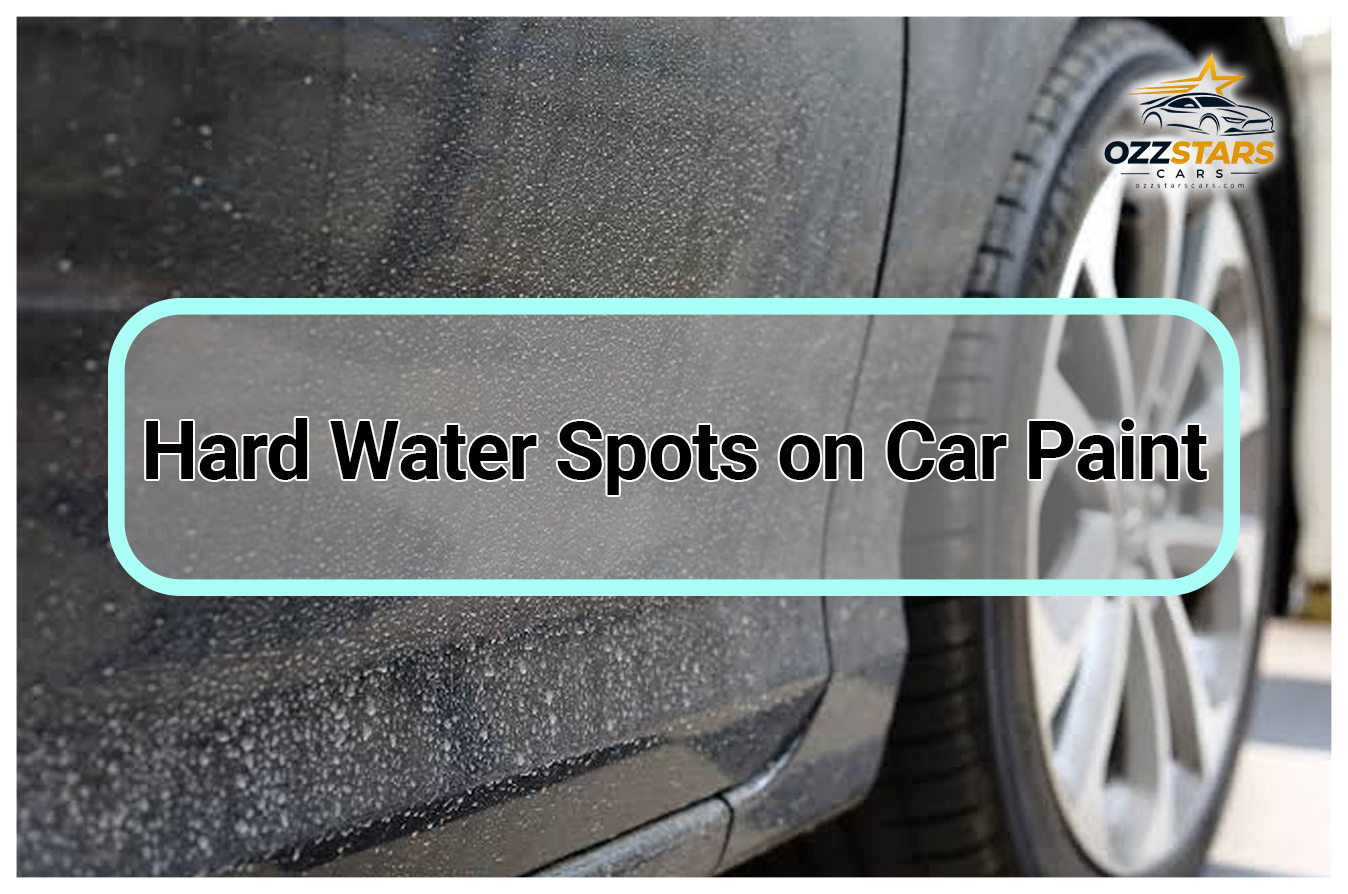
Hard Water Spots on Car Paint: Diagnose, Then Remove
Hard water spots on car paint are the minerals left behind when water droplets dry on the surface. Fresh spots sit on top and usually come off with a proper wash, a detail spray or a water spot remover. Spots left for a while bond more firmly and need a dedicated remover. If a faint ring is still visible after the minerals are gone, the spot has etched into the clear coat, and only careful polishing can level it. The key is working out which of those three you have before reaching for anything strong.
That diagnosis step is the part most guides skip, so it gets its own section below.
What hard water actually leaves behind
Tap water, well water and sprinkler water carry dissolved minerals. The U.S. Geological Survey's Water Science School page on hardness of water, read on September 27, 2026, defines hardness as "generally the amount of dissolved calcium and magnesium in water." USGS classifies water measured as calcium carbonate as soft at 0 to 60 mg/L, moderately hard at 61 to 120 mg/L, hard at 121 to 180 mg/L and very hard above 180 mg/L.
When a droplet sits on your hood, the water evaporates and the minerals do not. They are left in a small ring, often thickest at the edge where the droplet dried last. The same page notes the familiar spots and film on glasses coming out of a dishwasher. Your paint is getting the same treatment.
That is why the source of the water matters as much as how you wash:
- Rinse water from a hose in a hard water area
- Lawn sprinklers that hit the car every morning
- Drips from gutters, trees, air conditioners or a roof edge, landing on the same spot over and over
- Rain that picks up dust and pollution on the way down, then dries in the sun
If your water supplier publishes a water quality report, it will usually list hardness, so you can see where your own tap sits on that scale.
Why heat and sun make water spots worse
Evaporation is the whole problem, and sun and warm panels speed it up. A droplet on a hot hood dries before you can reach it with a towel, and the minerals are left behind in place.
Carmakers say the same thing in plain terms. Kia's EV6 owner's manual, in its exterior care section read on September 27, 2026, says not to "wash the vehicle in direct sunlight or when the body of the vehicle is warm," and adds: "Do not allow soap to dry on the finish." Our guide to washing a car in direct sunlight walks through what goes wrong when you do.
Three kinds of hard water spots on car paint
Spots that look identical from a few feet away can be very different problems. Detailers commonly sort them into three stages, and the stage decides the fix.
| Stage | What it is | What it looks and feels like | Typical fix |
|---|---|---|---|
| Surface deposit | Loose minerals sitting on top | Chalky rings that may feel slightly raised | Wash, or a detail spray while fresh |
| Bonded deposit | Minerals stuck firmly to the paint or its protection | Rings survive a normal wash | Dedicated water spot remover |
| Etching | Clear coat itself is marked | A crater-like ring remains after the minerals are gone | Polishing, or a professional |
The progression is time and heat. A fresh spot on a cool car is a wash problem. The same spot baked in the sun for weeks can end up as a paint problem.
How to tell which one you have
Work through this in order on a clean, dry, cool panel in the shade.
- Wash and dry the car properly. Many "water spots" are just dirt outlines. If they are gone after a careful wash, you are done.
- Wipe one spot with a detail spray and a clean microfiber. If it comes off, it was a surface deposit.
- Look at it under a bright light at a low angle. If a white or gray ring is still there, it is bonded. Move to a water spot remover.
- After the remover, look again. If the minerals are gone but you can still see the outline of the ring in the reflection, especially as a slight dip, the clear coat is etched.
Is it on the paint or the glass?
The same minerals land on windows, and the marks look the same. The quick check is simple: if you can see the spots from inside the car against a bright background, they are on the glass. Treat glass as its own job, with products labeled for automotive glass. Do not assume a paint product or a paint polishing method suits glass, or the reverse. Everything below is for paint.
How to remove hard water spots from car paint
Start with the gentlest step and stop as soon as the spots are gone. Every step up the ladder removes more, and on paint, more means clear coat you cannot put back.
Step 1: Wash in the shade
Wash the car on a cool surface, out of direct sun, with a car wash soap. Dry it straight away rather than letting it air dry. Our comparison of the best way to dry a car after washing covers the options. Fresh surface deposits often disappear at this stage.
Step 2: Use a water spot remover for bonded spots
A dedicated water spot remover is formulated to dissolve mineral deposits. Most are mildly acidic, which is how they work on calcium and magnesium. Follow the label exactly: how long to leave it on, how to neutralize or rinse it, and which surfaces it is approved for.
Work one small section at a time on cool paint. Do not let the product dry on the surface. Rinse or wipe it off as directed, then wash the area.
Some people reach for household vinegar as a do-it-yourself version. It is also an acid, and like any acid it can soften or remove wax and some sealants. If you use it, rinse it off thoroughly, and plan to reapply protection afterward. We do not give a mixing ratio here, because there is no single safe one for every finish; a product made for car paint comes with its own instructions.
Step 3: Reapply protection
Water spot removers and acidic cleaners can strip wax and weaken sealants. Once the spots are gone, put a layer of protection back on so the next droplet sits on that layer rather than on bare clear coat.
Step 4: Polishing for etched spots
If the ring is etched into the clear coat, no chemical will lift it, because there is nothing left on top to dissolve. The only fix is to level the surrounding clear coat with a polish, or a compound for deeper marks, until the edge of the etching disappears. Our explainer on the difference between polish and compound covers which does what.
Polishing removes a thin layer of clear coat every time, so use the least aggressive product that works. Deep etching, or etching on a large area, is a good reason to get a quote from a paint correction professional rather than chasing it by hand.
Chemical safety
- Read the label and the safety warnings on any spot remover before you open it.
- Work in a ventilated space and wear the gloves or eye protection the label calls for.
- Never mix products. Acidic spot removers must not be combined with other cleaners, and bleach-containing products in particular must never be mixed with acids.
- Rinse thoroughly and do not let product run onto trim, rubber or glass unless the label approves them.
- Keep products away from children and pets.
Do ceramic coatings stop water spots?
Coatings help, but they do not make a car spot-proof. A coated surface sheds water more readily and gives minerals a sacrificial layer to sit on instead of the clear coat, which usually makes spots easier to remove. Water still evaporates on a coating, though, and hard water left to bake on a coated car can mark the coating too. Coating makers usually give their own advice on spot removal, so check the coating's care instructions first. Our guide on how to maintain a ceramic coating covers the routine.
How to prevent hard water spots
- Wash and dry in the shade, on a cool car, one section at a time in hot weather.
- Dry the car completely after every wash and after sprinklers or rain when you can.
- Move the car out of sprinkler range and away from gutter or tree drips.
- Consider softened or filtered water for the final rinse if your area has hard water.
- Keep the paint protected with a wax, sealant or coating, and top it up.
- Deal with spots early. A spot you remove this week is a wash job. The same spot next season may be a polishing job.
FAQ
Are hard water spots permanent?
Not usually at first. Surface and bonded deposits can be removed with washing or a water spot remover. They become harder to fix once they etch into the clear coat, which then needs polishing.
Can hard water spots damage car paint?
Yes, if they are left long enough, especially in heat. The minerals can etch the clear coat, leaving a ring that stays after the deposit is gone.
Will a regular car wash remove water spots?
Fresh ones, often. Spots that have bonded to the paint usually survive a normal wash and need a dedicated remover.
Is vinegar safe for water spots on car paint?
Vinegar is a mild acid and may help with light deposits, but it can strip wax. Rinse it off thoroughly and reapply protection. A product made for car paint, used per its label, is the more predictable choice.
How do I know if a water spot is etched?
Remove the mineral deposit first. If you can still see a ring in the reflection, especially one with a slight dip, the clear coat is etched and needs polishing.
Diagnose first, start gentle and protect the paint afterward. Most water spots are a lot less serious than they look.